Seoul Museum Unveils Two Free Exhibitions on Korea's Royal Past and European Artefacts
At the turn of the 20th century in Korea, crafting became more than tradition - it evolved into a tool for reinvention for a country experiencing an extremely turbulent time.
The Seoul Museum of Craft Art will open two special exhibitions on Tuesday, both of which center on the Korean Empire (1897-1910), the brief and ambitious period during which Korea tried to remake itself into a modern state, with crafts as one of its instruments.
The larger exhibition, "The Hybrid," which marks 140 years of diplomatic relations between Korea and France, gathers 24 objects from European collections - 23 from France and one from Germany, some of which have not been displayed in Korea in over 120 years. The second, "Folded Time, Unfolded Memory: Andong Palace," turns inward to focus on the royal women who lived on the museum's own grounds.
The two exhibitions are linked, in the words of museum director Kim Soo-jung, "almost like an omnibus."
"Although these are separate exhibitions, they are connected through the Korean Empire period," Kim said during a press conference at the museum in Jongno District, central Seoul, on Monday. "This was a time when people sought to strengthen the nation through craft and industrial innovation. They incorporated the aesthetics and advanced technologies of their time to create new forms of crafts that were still based on tradition."
One exhibition shows the broader history of the period, while the other delves deeper into what was happening behind the scenes. The title "The Hybrid" comes from a single line written by Percival L. Lowell, the American astronomer and diplomat who visited Korea in the 1880s during the Joseon Dynasty (1392-1910). Lowell was given a Western-style hat made from horsehair - the same horsehair used to make traditional gat (Korean men's hats) - by King Gojong (r. 1907-10) and described the object as a "hybrid" in his writing.
A version of that hat, on loan from the Rotenbaum Museum in Hamburg, Germany, sits near the craft museum's entrance, and it is the only known surviving example of a horsehair-made item adapted to a Western silhouette in the early 20th century.
The section past the entrance depicts craft as a diplomatic language. A blue-and-white jar decorated with a dragon motif, presented by King Gojong to Victor Collin de Plancy, the first French envoy to Joseon, sits beside a three-tier mother-of-pearl chest believed to have been gifted to Homer B. Hulbert, the American educator whom King Gojong sent abroad to protest the Japan-Korea Treaty of 1905.
There are pieces from the 1900 Paris Exposition, including a perforated blue-and-white porcelain plant stand believed to have won a silver medal at the fair and returning to Korea for the first time in 126 years, as well as porcelain vases produced in France using flambe glazes imported through Plancy's collection.
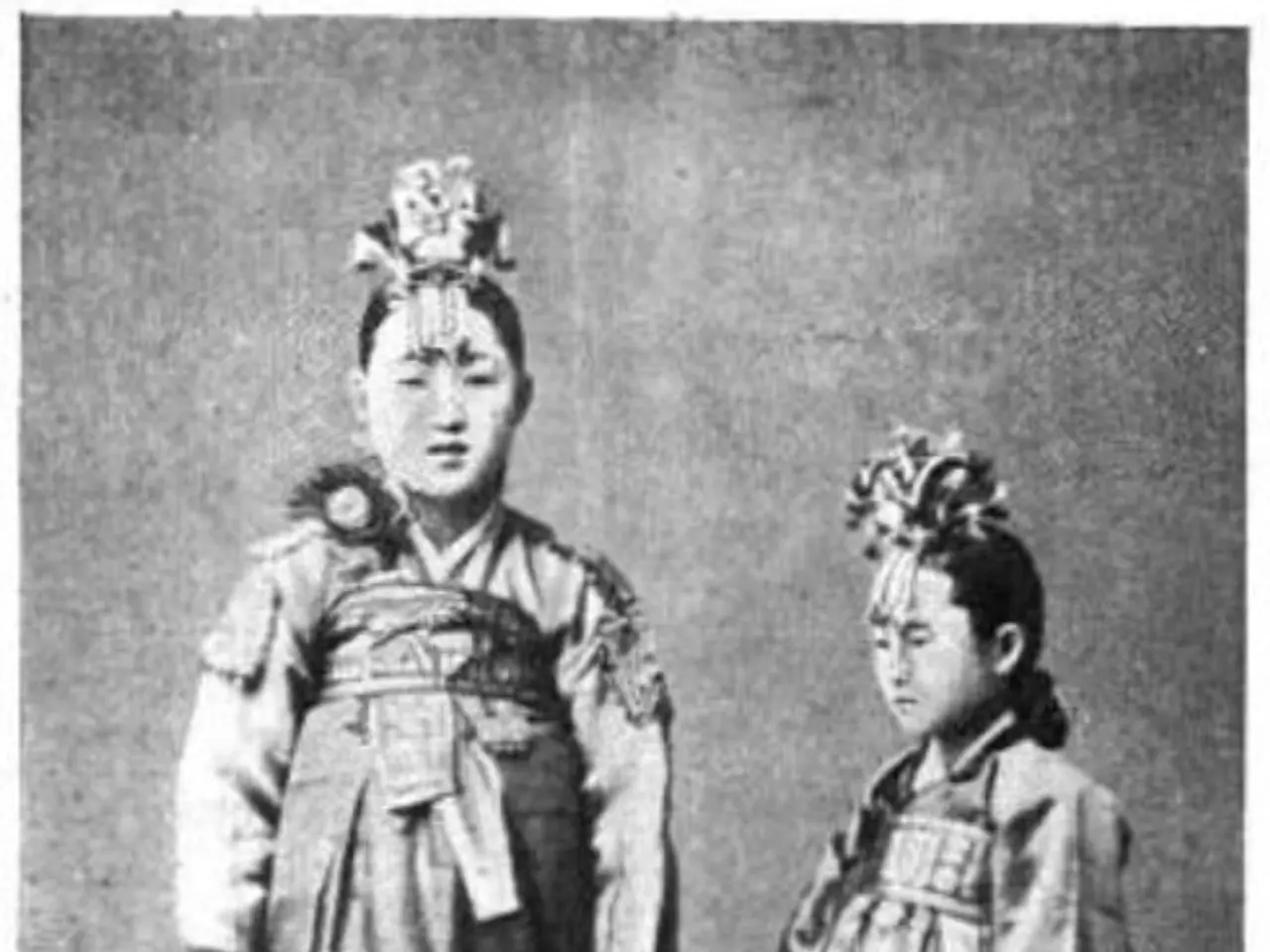
Meanwhile, "Folded Time, Unfolded Memory: Andong Palace" spotlights the domestic life of royal women during the Korean Empire. The exhibition centers on Empress Sunjeonghyo (1894-1966), who married the future Emperor Sunjong on the museum's site in 1906, and Princess Kim Deok-su (1878-1964), also known as "Uiwang," who was the wife of Prince Ui (1897-1970), the son of King Gojong, and spent her final years on the museum's grounds.
Both women converted to Catholicism late in life and donated their imperial garments to the Sisters of the Blessed Korean Martyrs, the country's first religious order founded by Koreans.
The standout artifact is the wonyugwan, a ceremonial crown believed to have been worn by Prince Ui and the only known surviving example of a wonyugwan. The original artifact will be on display for six days and will then be replaced by a replica to protect it from light.
The two exhibitions also feature contemporary work, with a geometric installation by French artist François Perrodin and a video-and-drawing piece by Korean illustrator Kwon Min-ho.
"The Hybrid" runs through July 26, and "Folded Time, Unfolded Memory: Andong Palace" runs through August 2027. Admission to both exhibitions is free, though the Seoul Museum of Craft Art is closed on Mondays.